
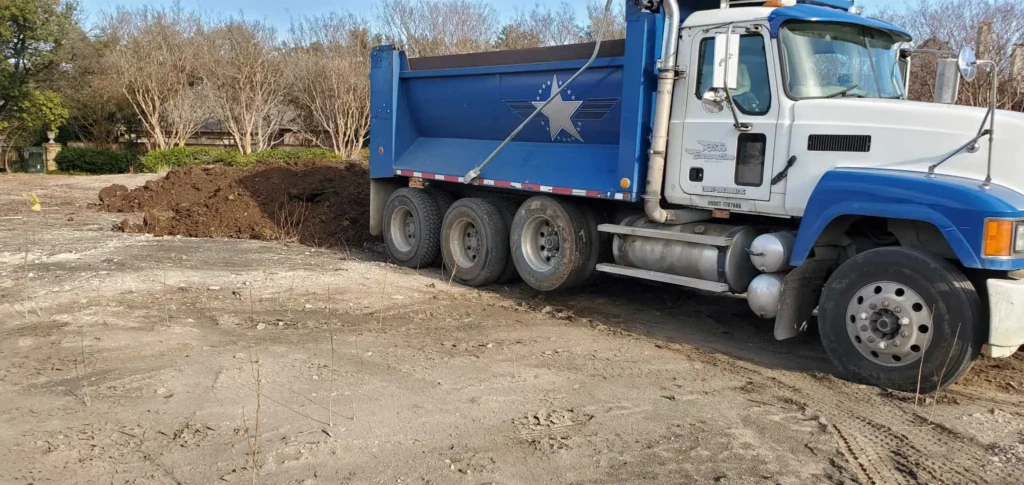
If you are ordering dirt by the load, that paragraph is most of what you need. The rest of this guide turns it into numbers you can plan with: load size by truck type, yard to ton conversions, how many loads your project takes, and when a bigger truck cuts your delivery bill.
At American Dirt Delivery we run dump trucks and 18-wheelers across 15 metros in 8 states, and these are the figures we use to size an order. For the truck by truck detail, including what stops a big truck reaching a site, see our dump truck sizes page.
Dump truck capacity chart for dirt
Working ranges, not specifications. Legal payload varies by state, axle configuration, the truck's own weight and how wet the dirt is on the day.
| Truck type | Realistic dirt load | Best for |
|---|---|---|
| Half-ton pickup | About half a cubic yard | Topping up a bed. 20 cubic yards is around 40 trips |
| Single-axle dump truck | 5 to 8 cubic yards | Small residential drops and tight access |
| Tandem-axle dump truck, the standard | 8 to 12 cubic yards | Most driveway deliveries |
| Tri-axle dump truck | 10 to 16 cubic yards | Larger residential and light commercial jobs |
| 18-wheeler end dump or belly dump | 16 to 24 cubic yards | Bulk volume onto open sites |
Two terms are worth knowing when you compare trucks. Struck capacity is the volume level with the top of the bed, and heaped capacity counts the pile above the rails. A supplier quoting heaped numbers sounds bigger, but weight law does not care how the load is shaped, which brings us to the real limit.
Why does weight, not volume, decide your load?
Here is the math that surprises most first-time buyers. A cubic yard of dirt weighs roughly 1.5 tons, about 3,000 pounds, which is the figure we use across this site. Dry, sandy fill comes in lighter than that and wet clay after a storm comes in heavier. A tandem dump truck rated for about 15 tons of payload therefore carries about 10 cubic yards of dirt, whatever its bed would hold in mulch.
So the same truck can deliver a different number of yards in a dry August than after a wet week in spring. That is not the supplier shorting you. It is the scale doing its job. It is also why quotes for heavy Texas clay fill can differ from quotes for lighter sandy fill in the same city, and why we sell by the cubic yard rather than by the truckload. Our dirt weight and conversions page covers fill dirt, topsoil and clay side by side.
Quick reference conversions:
- 1 cubic yard is 27 cubic feet
- 1 cubic yard of dirt weighs about 1.5 tons, roughly 3,000 pounds
- 10 cubic yards of dirt is roughly 15 tons
- Divide a truck's legal payload in tons by 1.5 to get the cubic yards of dirt it can carry
- 1 cubic yard spread 3 inches deep covers about 108 square feet
How many truckloads does your project need?
Use the formula: length in feet times width in feet times depth in feet, divided by 27, equals cubic yards. Then divide by the load size of the truck that can reach your site and round up. Three worked examples:
Raising a low backyard. A 50 by 40 foot area raised 6 inches needs 50 x 40 x 0.5 / 27 = about 37 cubic yards. That is 4 tandem dump truck loads at 8 to 12 yards each, or 2 loads on an 18-wheeler.
Filling in a pool. A 15 by 30 foot pool averaging 6 feet deep holds 15 x 30 x 6 / 27 = 100 cubic yards. That is 9 to 13 tandem loads, or 5 to 7 loads on an 18-wheeler. This is the kind of job where the bigger truck changes the economics.
Building up around a foundation. A band 3 feet wide and 6 inches deep around the perimeter of a 60 by 40 foot house runs 200 x 3 x 0.5 / 27 = about 11 cubic yards. That sits under our 20 cubic yard minimum, so it pairs well with a second job on the same property, such as filling low spots in the yard.
Rather not do the math by hand? Run your dimensions through the dirt calculator and you will have your yardage in under a minute.
When does an 18-wheeler beat a dump truck?
Most articles on this topic stop at the tandem dump truck, because most writers do not run 18-wheelers. We do, and the crossover point matters for your budget.
A tandem dump truck carries 8 to 12 cubic yards of dirt. An end dump trailer carries 16 to 24. Once your project needs about 20 cubic yards or more, 1 trailer trip can replace 2 dump truck trips, and because trucking is roughly 90 percent of what a load of dirt costs, fewer trips means a lower delivered price per yard. On jobs of 100 cubic yards and up the difference is large: 5 to 7 trailer loads instead of 9 to 13 truck loads.
The tradeoff is access. An 18-wheeler needs room to enter, tip and turn around, and an end dump needs firm, level ground to raise its bed safely. A loaded rig can weigh 70,000 pounds or more, so most residential driveways are off the table. We confirm access before we send the big trucks, and our delivery and trucking page spells out where and how we can tip. For tight residential sites the tandem dump truck is still the right tool. For open lots and commercial pads, the 18-wheeler is how you buy dirt at wholesale.
If you are also weighing what the dirt will cost, see our companion guide to fill dirt cost per load, which covers what moves the price and why common fill is usually the right call for volume work.
How should you plan the drop before the truck arrives?
A few site rules save every first-time buyer a headache:
- Pick a tipping spot on firm ground with overhead clearance, away from septic fields and buried utilities. Look up for power lines and branches.
- Remember the pile. 20 cubic yards heaped on a driveway takes about the footprint of a small car and stands about 6 feet tall.
- Keep the truck off standard residential concrete. Loaded trucks in the 50,000 to 70,000 pound range can crack a typical 4 inch driveway slab.
- If the dirt must be moved after it is tipped, plan for it. A single cubic yard takes 9 to 14 wheelbarrow loads, so 20 cubic yards is around 180 to 280 trips. A driver tips the load where you direct but does not spread it.
- Tell us about gates, slopes and soft ground when you order, and we will send the truck that fits.
How do you get the right truck for your order?
Order the truck that fits your yardage and your site, not whichever one a supplier happens to run. We deliver by tandem dump truck and by 18-wheeler across 15 metros, most orders arrive within 1 to 3 days from stock, and every quote is backed by our low price guarantee. Tell us your square footage and your address and we will size the load for you.