Clay Fill Dirt & Common Fill
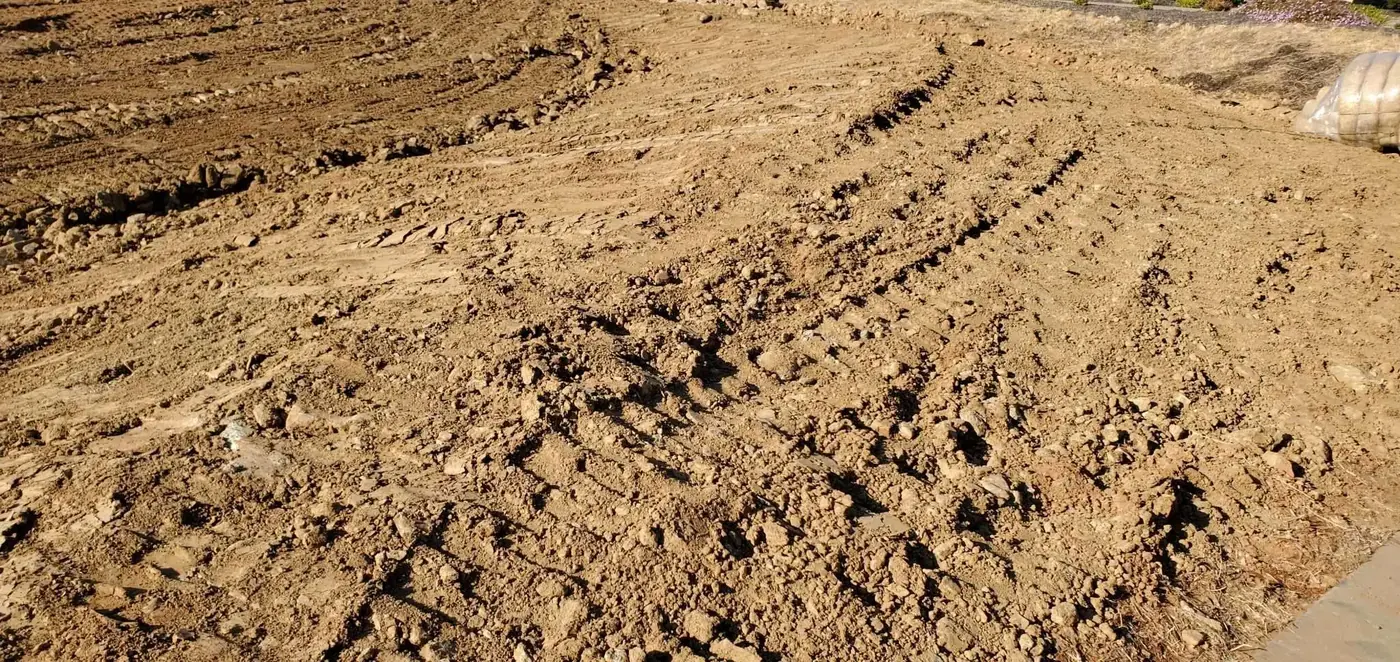
The bulk material. Over 80 percent of what we sell. Raising ground, filling holes, backfilling pools, shaping berms and tracks.
Read moreSelect fill is a graded blend chosen so it compacts to a predictable density. It goes under building pads, driveways and flatwork. It is placed in lifts of 6 to 8 inches loose and compacted lift by lift, usually to 95 percent or better of a Proctor maximum dry density named on your plans.
You are not paying for dirt, you are paying for predictability. Select fill is chosen for its gradation: enough sand and granular material to lock together under a compactor, and enough fines to bind it. Run a plate compactor or a roller over it and you get a dense, stable layer that does not keep moving afterwards.
Clay fill will not do that reliably. Clay compacts to a density that depends heavily on its moisture content on the day, and then it swells and shrinks with the seasons for the rest of its life. Under a slab that is a foundation problem rather than a soil problem. Select fill is what goes there instead.
It often has a reddish cast in our Texas markets and a visibly more granular, sandy feel than clay fill. Colour is a weak test though. The property that matters is what happens under a compactor, and that is measured, not looked at.
Building pads under residential and commercial slabs. Driveway and parking bay subgrade. The base layer under sidewalks, patios and flatwork. Backfill against retaining walls and around footings where you need the ground behind the structure to stay put. Anywhere a structure sits on dirt and the dirt is expected to hold still.
It is also the right call for raising a pad where the native ground is highly expansive. Across the Blackland Prairie around Dallas and Fort Worth, and in the Gulf Coast clays under Houston, building a pad out of imported select fill rather than reworking the native black clay is standard practice, and it is the single biggest use of bulk material in those 2 metros.
What it is not for is growing anything. Select fill is a construction material with no meaningful organic content. If a landscape plan calls for a growing medium, that is topsoil or a blended planting mix, and it is a different order.
In lifts, not in one heap. The usual approach is to spread it in layers of 6 to 8 inches loose, then compact each layer before the next one goes on. Compacting the top of a 3 foot pile does nothing for the bottom 2 and a half feet of it, and an inspector with a nuclear density gauge will find that out before you do.
Moisture matters more than people expect. Compaction testing works against a Proctor curve, which relates density to moisture content, and there is an optimum. Too dry and the particles will not pack together no matter how many passes you make. Too wet and the material pumps under the roller instead of densifying. On a hot Texas afternoon a pad can dry past workable inside a day, which is why delivery timing lands on the critical path of a lot of jobs.
Expect the compacted volume to be meaningfully less than the loose volume you had delivered. That is the compaction doing its job. Order against loose volume with a 20 to 25 percent allowance for a pad being built to a spec, rather than ordering the finished in-place volume and coming up short.
If your project has an engineer or a geotechnical report attached, there is a good chance the plans name a specific material and a specific standard. In Texas the reference you will see most often is a TxDOT item number for embankment or base material, usually with a plasticity index ceiling and a liquid limit attached. Plasticity index is an Atterberg limit: it measures how much water a soil can take on before it behaves like a liquid, and a low number means low shrink and swell.
The compaction requirement is normally written as a percentage of a maximum dry density determined by a Proctor test, standard or modified. Standard Proctor is ASTM D698. Modified Proctor is ASTM D1557 and it is the heavier test. A pad called to 95 percent standard and a pad called to 95 percent modified are not the same requirement.
Read that before you order. We will tell you straight whether what we can source for your area is likely to meet what your plans call for, and where it will not, we will say so. What we will not do is take the order and let you find out at inspection. If the spec is tight, send it to us and we will look at it first.
Working properties for select fill. The numbers in the compaction rows are the values commonly written on plans in our markets, not a guarantee about a specific load. Anything your engineer has specified overrides everything on this page.
| Property | What to expect |
|---|---|
| Sold by | The cubic yard, 27 cubic feet |
| Minimum order | 20 cubic yards |
| Rough weight | About 1.5 tons per cubic yard, heavier wet |
| Lift thickness | 6 to 8 inches loose, compacted lift by lift |
| Typical compaction called | 95 percent of a Proctor maximum dry density |
| Standard Proctor test | ASTM D698 |
| Modified Proctor test | ASTM D1557 |
| Plasticity index | Named as a ceiling on most engineered jobs |
| Compaction allowance | Budget 20 to 25 percent over the in-place volume |
| Relative cost | Between clay fill and topsoil |
Select fill is a Texas word before it is anything else. Demand for it in our Texas metros is an order of magnitude above what we see further afield, where the same job gets specified under different names, structural fill on the Front Range, engineered fill in California.
The defining product of this market. The Blackland Prairie clay through the eastern half of the metroplex is among the most expansive soil in North America, and the standard answer is to isolate the slab from it with a pad of imported select fill compacted in lifts. Almost every residential slab in the northern growth corridor sits on one. More on the ground under Dallas-Fort Worth.
The same job on different ground. The Beaumont Formation clays under greater Houston swell and shrink hard, and pads, driveway subgrade and flatwork bases get built out of imported material for that reason. Floodplain rules in parts of Harris County add a required elevation on top of the structural question. More on the ground under Houston.
Ask for structural fill here rather than select fill. It is the Front Range term for the same idea: a compactable, non-expansive fill used under foundations and pavements, often placed after over-excavating unsuitable claystone. Class 6 road base is a separate base course that sits above it. More on the ground under Denver.
California plans say engineered fill and import fill. Engineered fill is a method rather than a product: a defined material placed in defined lifts, compacted to a defined density and tested. Nothing is engineered fill until it has been placed and tested as such. More on the ground under Sacramento.
Work out the in-place volume first. A 40 foot by 50 foot pad built up 12 inches is 40 by 50 by 1, which is 2,000 cubic feet, or about 74 cubic yards compacted in place.
Then add the compaction allowance, because you buy loose yards and you place compacted ones. At 20 to 25 percent, that 74 yard pad wants 89 to 93 cubic yards delivered. Ordering the in-place figure is the most common way a pad runs short on the last lift, and the last lift is exactly where you do not want a second delivery charge on 15 yards.
Fill dirt is whatever mineral subsoil the pit produces, bought for volume. Select fill is a graded blend chosen so it compacts to a predictable density, bought for structural performance. Fill dirt goes where you need mass. Select fill goes under anything that carries load, placed in 6 to 8 inch lifts and compacted.
No. Those are different products with different gradations and different prices. Select fill sits between common fill and a true engineered granular base. Bank sand is a sand and clay mix used for levelling. Road base and flex base are compacted base courses that sit above the fill. If your plans name a product, order that product by name.
No, not usefully. Select fill is a construction material with almost no organic content, chosen for how it behaves under a compactor rather than for what will live in it. If grass has to grow over a select fill pad, cap it with 4 to 6 inches of topsoil first.
No. We deliver material. Placement, lift thickness, moisture conditioning and compaction are the job of your crew or your grading contractor, and on an engineered job the density testing is normally a third party's. Tell us how you want the load dropped and we will work with your site.
Around 1.5 tons as a planning figure, the same rule of thumb we use for dirt, sand and aggregate generally. It moves with moisture content and with the gradation of the particular blend, so treat it as a number for working out truck loads rather than a scale reading.
Select fill carries load. For bulk volume and for anything that has to grow, these are the other 2 materials we carry.
The bulk material. Over 80 percent of what we sell. Raising ground, filling holes, backfilling pools, shaping berms and tracks.
Read more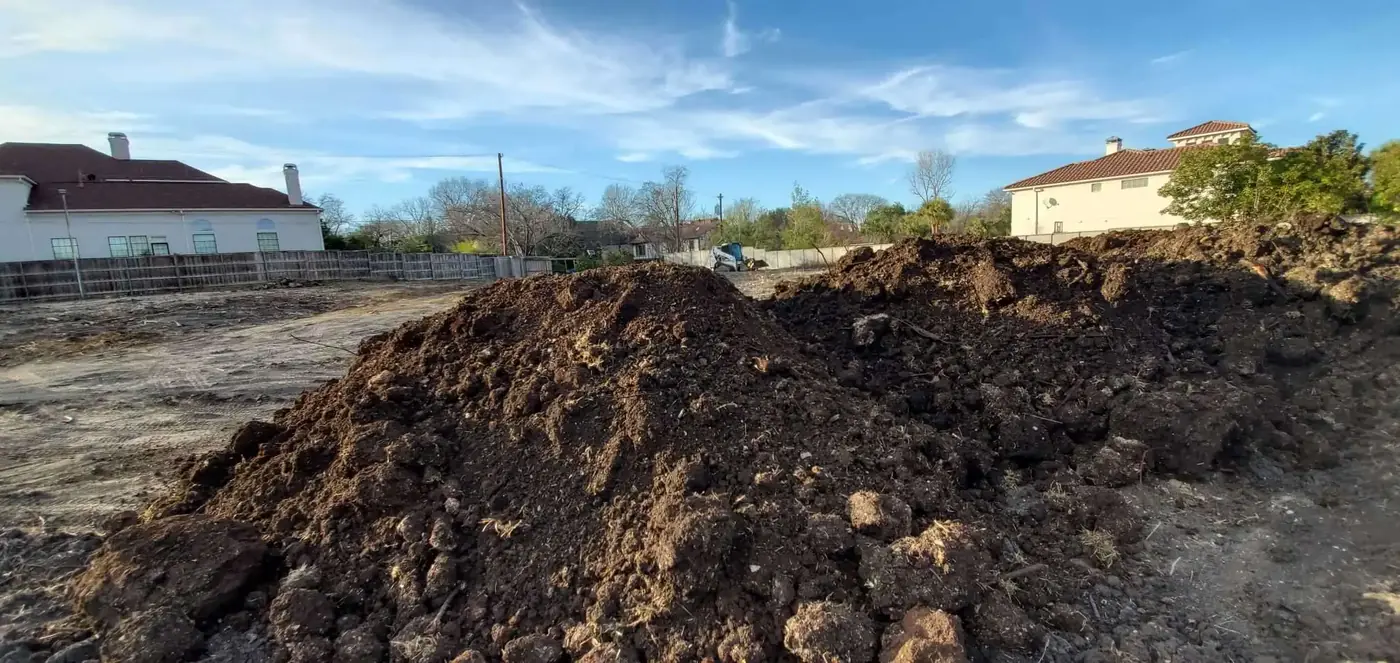
The growing layer. 4 to 6 inches over a prepared grade for lawn, 8 to 12 inches for beds. The dearest of the three, because there is least of it.
Read moreDescribe the job and the site and we will tell you which of the three actually suits it. That conversation costs nothing. A wrong load costs the trucking twice.