Select Fill Dirt
The spec-driven fill. Building pads, driveway subgrade, flatwork base and backfill against retaining walls. It compacts and it stays compacted.
Read moreFill dirt, also called common fill, is the mineral subsoil below the topsoil layer. Ours runs clay-heavy. It is bought for volume: raising ground, filling holes, backfilling pools. It is the cheapest of our 3 materials and it is over 80 percent of what we sell, in loads from 20 cubic yards up.
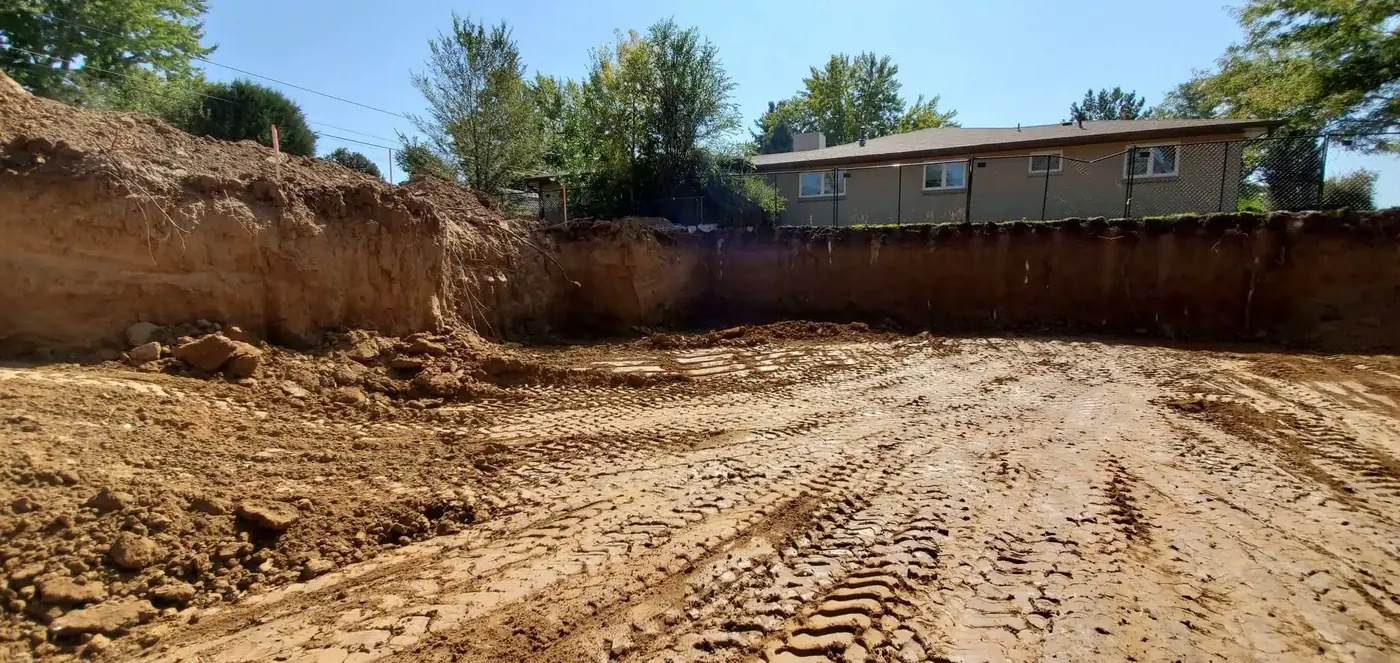
Fill dirt is what you hit once the organic layer is stripped off a site. It is the mineral soil below: clay, silt and sand in whatever ratio that ground happens to have, with very little organic matter left in it. Ours runs clay-heavy, which is what gives it the behaviour people buy fill for.
It runs chunkier than screened material and it may contain some organic matter. That is normal for fill and it is not the same thing as dirty dirt. Clean is the standard we hold: no concrete, no rebar, no asphalt, no construction trash. A contaminated load is a load you pay a second person to haul away.
You will hear the same material called common fill, general fill, fill, or just dirt. In our markets those words are used interchangeably by contractors and by us. Select fill is a different product entirely and it is not a grade of fill dirt.
Clay fill hardens as it dries and holds its form. That is the whole point of it. Build a berm out of clay fill, let it dry, and the berm stays a berm. It is why pond banks, levee shaping, soccer field crowns and motocross jump faces are built out of it. Jerry shaped track out of this material before he sold a yard of it.
The flip side is that it gets muddy when it is wet, and clay holds water far longer than sand does. Freshly placed fill in a wet week is a mess to walk on. Once grass roots into it the root mat holds it and it stops moving. If you are placing a lot of it, watch the forecast. Wet fill is heavier per cubic yard, harder to spread, and it will not compact properly.
The deeper behaviour is shrink and swell. Clay takes on water and expands, then dries out and contracts. In the Blackland Prairie east of Fort Worth that movement opens surface cracks wide enough to lose a tape measure down in a dry August. It is a useful property when you want mass and a serious problem when you want something to sit still.
Raising land and bringing low areas up to grade. Filling holes. Building berms around ponds. Backfilling a pond, a pit, or a swimming pool that is being decommissioned. Building up ground for a soccer, football or lacrosse field. Shaping a motocross or BMX track, because clay fill holds a lip and a face once it dries.
It is also the material for regrading around a house. The ground next to a slab wants positive fall away from the building, and over 20 or 30 years it settles until the fall runs the wrong way. A few cubic yards of clay fill regraded around the perimeter sends water away instead of letting it stand against the slab. In Houston and across DFW that is one of the cheapest things a homeowner can do for a foundation.
Pool fills are the single job people most often under-order for. A decommissioned pool is not a box. It has a shallow end, a deep end and a transition, so the average depth across the footprint often lands nearer 5 feet than the 3 feet people picture. A modest residential pool can swallow 60 to 100 cubic yards once the deep end is accounted for.
Do not plant into it. There is close to nothing in fill dirt for a plant to live on. Grass seeded straight into clay fill will struggle in the first dry spell because the roots hit dense, dead ground. If you are building a bed or laying sod, fill dirt goes in as bulk and 4 to 6 inches of topsoil goes on top as the growing layer.
Do not use it as structural fill under a slab or a driveway unless an engineer has specifically approved it. Clay swells when it takes on water and shrinks when it dries, and that movement is what cracks foundations and flatwork. Under anything that carries load you want select fill, placed in lifts and compacted.
Do not use it as the final surface on anything you need to stay level. Loose fill consolidates as it sheds water and settles under its own weight. If a finish level matters, the fill has to be placed in lifts and compacted rather than tipped in one heap and raked over.
You will want a machine. Clay fill comes off the truck in a pile and it is heavy, chunky material. A skid steer, a tractor with a loader or a small dozer will move in 20 minutes what a crew with shovels would take most of a day to shift. At roughly 1.5 tons per cubic yard, a 20 yard load is about 30 tons sitting on your driveway.
If you have no machine and no way to get one, say so when you order, because it changes where the truck should tip. A pile 60 feet from where the material needs to end up is a very different weekend from a pile placed correctly. The driver tips where you direct them, and they only do it once.
Working properties for clay-heavy common fill. Every figure moves with moisture content and with the pit the material came out of. Treat them as planning numbers rather than a specification, and if your job carries a real spec, send it to us before you order.
| Property | What to expect |
|---|---|
| Sold by | The cubic yard, 27 cubic feet |
| Minimum order | 20 cubic yards |
| Rough weight | About 1.5 tons per cubic yard, heavier wet |
| Screened | No. Fill runs chunkier than topsoil by nature |
| Organic content | Minimal, and it may contain some |
| Compacts predictably | No. Density depends heavily on moisture on the day |
| Placement | In lifts if the finish level matters |
| Settlement allowance | Budget 10 to 20 percent over the calculated volume |
| Will plants grow in it | Barely. Cap it with topsoil if anything has to grow |
| Relative cost | The cheapest of our 3 materials |
Fill dirt is the same product in every market and it does a slightly different job in each of them, because the ground it is going onto is different. These are the local patterns we see most.
Pool fills and lot raising dominate. The coastal plain is flat and close to sea level, so water sits rather than runs, and most fill in this market is being used to raise something above the ground around it. Perimeter regrading around slab foundations is the other constant. More on the ground under Houston.
Levelling former farmland is the volume job here. Old agricultural ground out toward Cedar Hill, DeSoto and west of Fort Worth carries plough furrows, stock tanks and erosion gullies, and bringing that to a mowable or buildable grade takes clay fill by the hundred yards. Sports field and track shaping too. More on the ground under Dallas-Fort Worth.
Fill goes into levelling building envelopes and yards on sloping Front Range lots, and into backfilling trenches, window wells and post holes where the native spoil is rock and claystone. Bringing in clean fill is often faster than trying to reuse what came out of the hole. More on the ground under Denver.
Building up contours for landscape conversions and raising pads on the valley floor. Pool removals fill the same way they do anywhere. Out toward Elk Grove and Rio Linda the rural parcels take real volume for levelling and driveway base work. More on the ground under Sacramento.
Multiply the length in feet by the width in feet by the depth in feet, then divide by 27. For a depth given in inches, divide the inches by 12 first. A 30 foot by 40 foot low area raised by 8 inches is 30 by 40 by 0.667, which is 800 cubic feet, or about 29.6 cubic yards.
Then add for settlement. Loose fill tipped and spread will consolidate, so for anything where the finish level matters, budget 10 to 20 percent over the calculated volume. On that 29.6 yard example, order 33 to 36 cubic yards. Running 3 yards short means a second trucking charge on a small quantity, which is the most expensive dirt you will ever buy.
Yes. Fill dirt, common fill, general fill and fill all describe the same material in our markets: the mineral subsoil below the organic layer. We use the terms interchangeably and so will most contractors you talk to. Select fill is not a synonym for any of them.
Yes, if it is tipped and spread. Loose fill consolidates as it sheds water and settles under its own weight. For anything where you care about the final level, it should be placed in lifts of 6 to 8 inches and compacted rather than dumped in one heap. Budget 10 to 20 percent extra volume for the settlement.
No. Fill is a bulk material and it runs chunkier than topsoil. What we guarantee is that it is clean, meaning free of concrete, rebar, asphalt and construction debris. If your job needs material screened to a specific size, tell us before you order so we can tell you honestly whether we can source it for your address.
More than you think. Estimate the average depth across the whole footprint rather than using the shallow end. For a typical residential pool that average often lands near 5 feet, which puts a 16 foot by 32 foot pool around 95 cubic yards. The shell is normally broken up first so water drains through instead of collecting in a bathtub.
Not well and not for long. Fill dirt has almost no organic matter and almost nothing for a root system to feed on. Grass seeded directly into clay fill fails in the first dry spell. Build your grade with fill, then cap it with 4 to 6 inches of topsoil before you seed or lay sod.
Fill dirt covers volume. If the ground has to carry load or grow something, one of these two is the material you actually want.
The spec-driven fill. Building pads, driveway subgrade, flatwork base and backfill against retaining walls. It compacts and it stays compacted.
Read more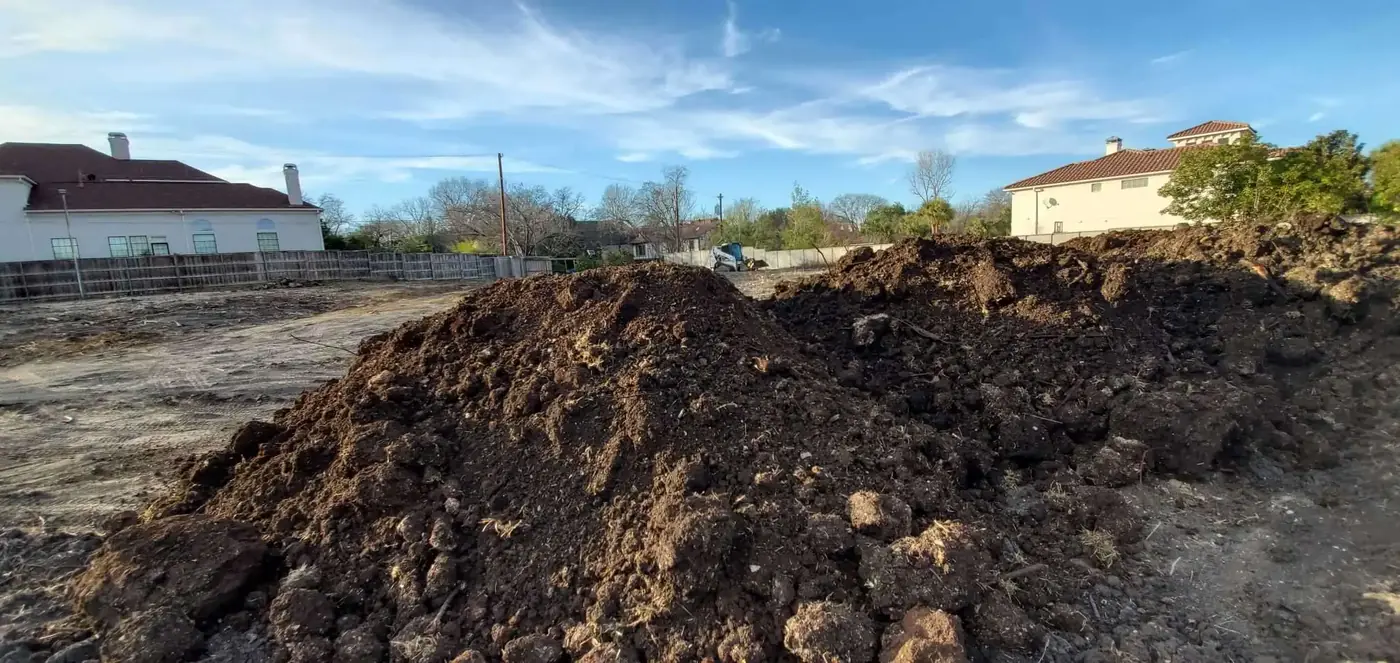
The growing layer. 4 to 6 inches over a prepared grade for lawn, 8 to 12 inches for beds. The dearest of the three, because there is least of it.
Read moreDescribe the job and the site and we will tell you which of the three actually suits it. That conversation costs nothing. A wrong load costs the trucking twice.